
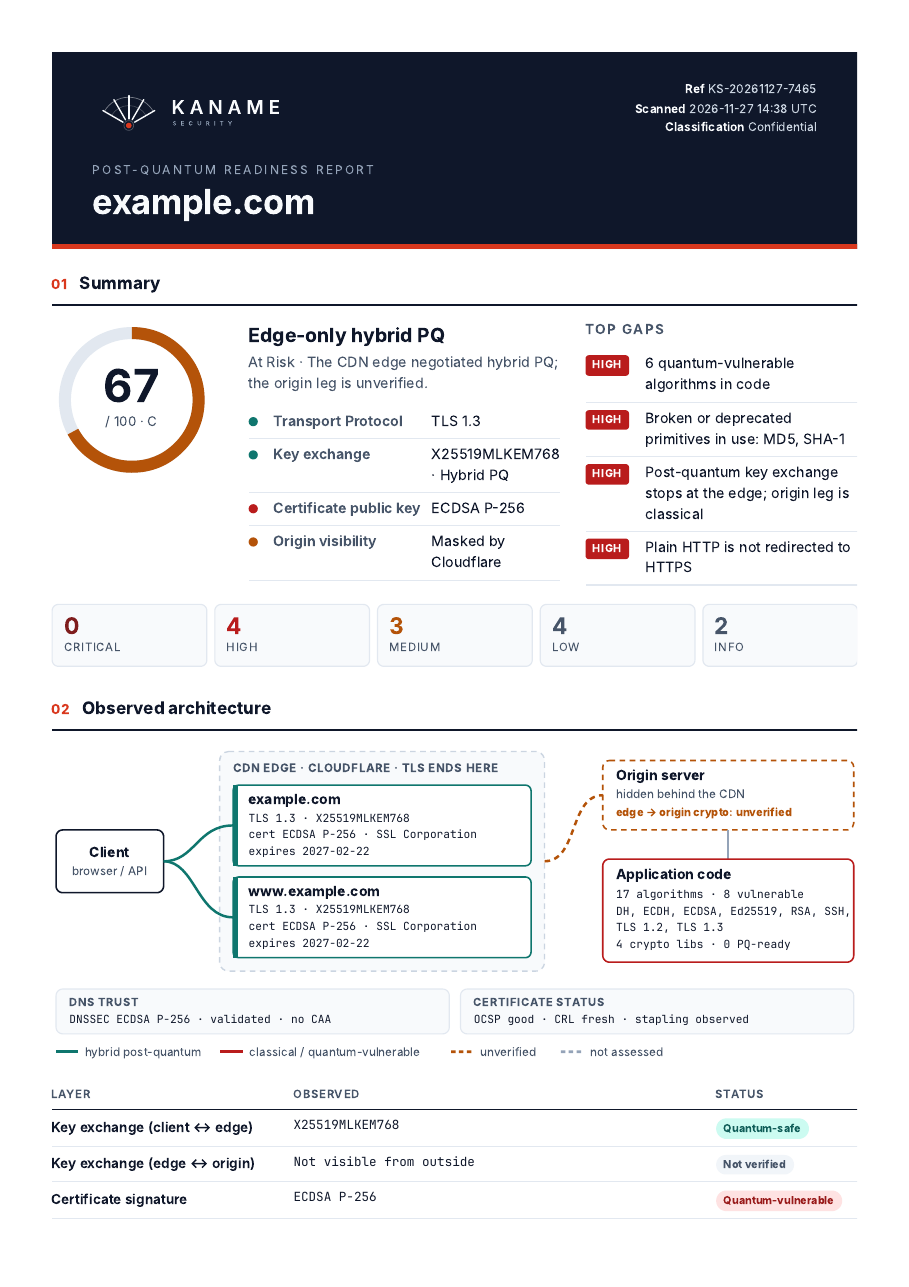
Kaname Scan combines a real hybrid post-quantum TLS probe of a public endpoint with a static cryptographic inventory of the repository. It scores readiness from 0 to 100 and writes the evidence behind every finding.
| Report (HTML, PDF) | Verdict, score breakdown, gap register, actions, roadmap and evidence tables. |
|---|---|
| report.json | Every observation and finding, machine-readable. |
| cbom.json | CycloneDX 1.6 CBOM: algorithms, protocols, TLS endpoints and key material, tagged with NIST IR 8547 quantum risk. |
| sbom.json | CycloneDX 1.6 SBOM across 12 manifest formats, with each crypto library annotated for post-quantum capability. |
100 points across six dimensions. The signature dimension is capped because no public CA issues ML-DSA certificates yet, so a well-run public posture scores in the low 90s today.
| Dimension | Max | What earns points |
|---|---|---|
| Key exchange (harvest now, decrypt later) | 35 | Hybrid post-quantum key exchange on every tested endpoint. |
| Signatures and certificates | 20 | ML-DSA or SLH-DSA. Classical keys earn partial credit for modern curves and short lifetimes. |
| Estate coverage | 15 | Every tested host negotiates post-quantum key exchange. |
| Transport hardening | 12 | TLS 1.3 only, HTTPS redirect, long-lived HSTS. |
| Crypto-agility operations | 10 | Working revocation, CAA, DNSSEC. |
| Email authentication | 8 | DMARC reject, strict SPF, discoverable DKIM. |
Requires Python 3.9+ and OpenSSL 3.5+ for ML-KEM groups. Chrome or Chromium is optional, for PDF output.
kaname website example.com        # live endpoint only
kaname repo .                     # code inventory: CBOM + SBOM
kaname scan example.com --repo .  # full assessment
kaname doctor # toolchain checkkaname scan "$SERVICE_DOMAIN" --repo . \
--fail-under 60 --no-pdf --out artifacts/pqcA new hardcoded RSA key or a dropped post-quantum group lowers the score and fails the build. The CBOM diff between builds becomes the audit trail.